
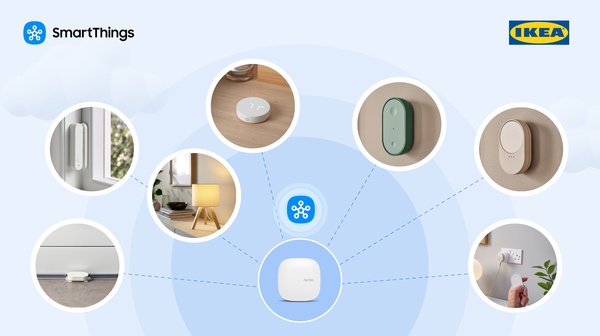
Samsung's SmartThings platform will from now on directly support 25 new IKEA devices that use the Matter-over-Thread standard. IKEA released a bunch of Matter-compatible smart devices at the end of last year.
In practice, this means that consumers can connect IKEA's popular smart bulbs, sockets and sensors directly to Samsung's smart home hub without needing IKEA's own Dirigera bridge.
Previously, cross-using these two systems often required both manufacturers' own hubs, which increased both costs and technical complexity.
Technically, the change relies heavily on the Matter-over-Thread combination, which is one of the most significant developments in the smart home world in years.
Matter is, so to speak, a common language between manufacturers that ensures compatibility between devices from different brands, while Thread is a low-power mesh networking technology designed specifically for the needs of small smart home devices.
The importance of the technology lies in the fact that Thread devices form a self-healing network among themselves and consume only a fraction of the energy required by Wi-Fi devices. This makes it possible, for example, for small door or water leak sensors to run on a single battery for years, while still maintaining a fast response time and better range than traditional solutions.
The newly announced support covers a wide range of IKEA products, including air quality, temperature and humidity sensors, as well as an interesting rotatable remote control. With the remote, users can control, for example, lighting brightness or smart blinds more precisely than with traditional buttons.
At the same time, Samsung has adopted the latest Thread 1.4 standard, which further improves the ability of Thread networks from different brands to operate as a unified whole together with other smart home devices such as televisions and washing machines.
In practical applications, the collaboration is visible, for example, through the SmartThings Family Care feature, where IKEA's affordable door sensors can be used to monitor the daily life of elderly relatives.
The system can also analyze bedroom conditions based on data collected by the sensors and provide suggestions for achieving an optimal sleep environment, such as lowering the temperature to 19-21 degrees.
Samsung's goal is to remove the financial and technical barriers to building a smart home by enabling the seamless use of high-quality yet affordable devices as part of a broader ecosystem, regardless of what brand the devices originally are.
Written by: Petteri Pyyny @ 21 Apr 2026 14:03
